

Jun
10 Popular Types Of Natural Stone Countertops
- 2026
- FlintStoneTops
Natural stone countertops have this unmistakable natural feel, unique appearance, and excellent durability, but they can be costly and high maintenance, and you have to choose from a lot of types, which can be confusing. There are many more natural countertops than the popular ones: marble and granite countertops. So, here are some common and popular types of natural stone countertop surfaces you can choose for your kitchen.
Types of Natural Stone Countertops
Granite Countertops
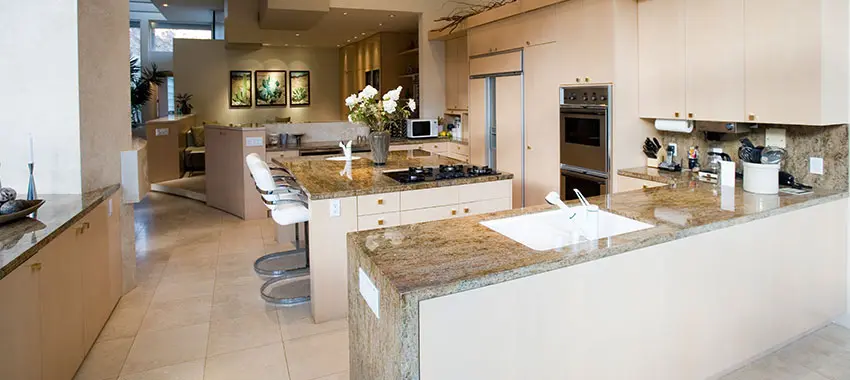
Granite is the most popular type of natural stone countertop surface. The reasons are its aesthetics, durability, heat-resistance, scratch-resistance, and availability. Granite countertops can last for decades and due to that, adding granite countertops to your kitchen can boost your home’s value.
Another great thing about granite countertops is their huge variety. You can find most kinds of colors and patterns, such as white, black, blue, red, green, yellow, and brown. There are also many exotic colors of granite, like vivid blue, emerald green, purple, multicolor slabs, etc., though those are more expensive.
Marble Countertops
Marble countertops are all about appearance. They offer unique and unmatched beauty, even though they are not as durable, scratch-resistant or heat-resistant as granite or most natural stone countertop options.
With mediocre durability and high maintenance, you would think that marble countertops won’t add value to your home, but if you know anything about countertops, you know that marble surfaces offer excellent ROI in high-end, luxury homes. However, if you also want practicality with a higher home value, either choose granite or quartzite countertops – in the realm of natural stone countertops.
Quartzite Countertops
This natural stone is very similar to marble in appearance, but it’s highly durable, scratch-resistant, and heat-resistant. Quartzite feels like nature kind of gave us a hybrid of granite and marble. We get the looks of marble and the durability of granite.
In addition to that, quartzite has an impressive color variety. You can find many shades with dramatic veining, like white, gray, beige, pink, blue, and more. It also improves resale value, but it costs more compared to granite and is similarly priced as marble.
Soapstone Countertops
Soapstone countertops are fairly durable and heat-resistant. But the unique thing about them is that, unlike other natural stones, they are almost non-porous. So, you don’t need to seal them as frequently. They are commonly available in blue, gray, green, and black colors and offer a rustic appearance. Moreover, soapstone surfaces develop a natural patina or shade over time, which is liked by many people while disliked by others.
The downside is that they are not as hard as granite or quartzite and can be scratched easily. Soapstone slabs are usually costlier than granite and sandstone, and cheaper than quartzite and marble countertops.
Sometimes, people confuse it with sandstone, which is a much cheaper, softer, more porous, and less durable natural stone countertop option.
Limestone Countertops
Limestone is a unique natural stone. It has soft, earthy tones that work well with most types of kitchen styles, be it traditional, transitional, modern, contemporary, or minimalist. Commonly, limestone has beige, cream, white, off-white, gray, yellow, and brown tones. You can also get fossil-rich multi-tone limestone slabs if you want the countertop to be the focal point of your kitchen.
So, it offers luxury-like aesthetics without being as costly as marble, quartzite, or high-end granite. However, the problem is that it’s a soft stone and prone to scratches and damage. Plus, it’s highly porous, much like sandstone, so frequent sealing must never be ignored. On top of that, limestone is also sensitive to chemicals much more than other natural stones. So, you have to take care of it.
Travertine Countertops
A type of limestone, travertine offers a soft, warm appearance with earthy tones like cream, ivory, beige, tan, walnut, gold, reddish brown, etc. These countertops are usually for rustic, traditional, and Mediterranean style kitchens.
Travertine has the durability and heat resistance associated with natural stones, but it’s still much softer and more porous than most natural stones, making it prone to stains, scratches, chipping, and etching. But all in all, it’s a good, cheap alternative for budget-friendly kitchens that want to look luxurious.
Slate Countertops
You may commonly hear about slate in roofing, but the metamorphic rock is also used for flooring and countertops. Slate has its uniqueness in colors and offers a muted color range, such as charcoal, black, green, and gray. They couple perfectly with a matte finish. However, the color choices are limited.
Similar to soapstone, slate countertops are also almost non-porous and requires less frequent sealing compared to granite and marble. It’s also highly heat resistant and can withstand outdoor conditions if installed in an outdoor kitchen. Plus, it’s low cost compared to quartzite, marble, and other high-end natural stones.
Even though slate is durable, it’s prone to chipping due to its layered composition. It can also be scratched by cleaning tools or harsh chemicals. However, this is true for most natural stone and also engineered stone countertop materials.
Onyx Countertops
When it comes to luxury countertops and statement pieces, onyx countertops are highly regarded. Their dramatic veining, striking colors and patterns, and translucent nature help them take the center stage wherever they are installed. The translucency is amplified with backlighting for maximum visual impact.
But there are many downsides to onyx countertops. The predictable one is that they are one of the most expensive natural stone countertop options. Onyx is also fragile and soft, as it ranks 3 to 4 on the Mohs scale (granite is 6-7, quartzite is 7, and marble is 3-5). So, it can chip, scratch, or even crack with high impact. It can also be etched with chemicals and is highly porous.
So, onyx countertops are not for busy kitchens or primary kitchen worktops. They are usually for low-traffic spaces or parts of the kitchen.
Basalt Countertops
Basalt in Latin means “very hard stone”, though it ranks 5-6 on the Mohs scale, and granite and quartzite rank higher than it in hardness. But still, it’s a hard and durable stone, just not as hard as granite, and can be scratched with knives. You will mostly see basalt countertops in modern and contemporary kitchens for their uniform and elegant dark gray to black color tones.
Like other natural stones, basalt is porous and requires sealing. It’s also susceptible to acids and can be etched if spills are not cleaned immediately or if acidic cleaners are used.
Sandstone Countertops
As stated in the soapstone section, sandstone countertops are budget-friendly and offer earthy tones for kitchens and bathrooms, like gray, charcoal, brown, tan, beige, and others. It also handles heat well, but that’s about it when it comes to the benefits.
Its drawbacks include high porosity, which prompts you to seal it once every few months, and poor durability that encourages scratches, dents, and damage.
Other Natural Stones
There are other natural stones as well, which include bluestone, dolomite, schist, serpentine, gneiss, and other exotic natural stones.
Conclusion
When it comes to natural stone countertops, granite is the most popular one, followed by marble and quartzite. They make up more than 90% of natural stone countertops in the U.S. However, there are other niche options as well to suit a kitchen style or vibe. So, you have a lot to choose from. To check out the samples of various natural stones and for proper fabrication and installation, get in touch with a granite contractor Rockville.