

Apr
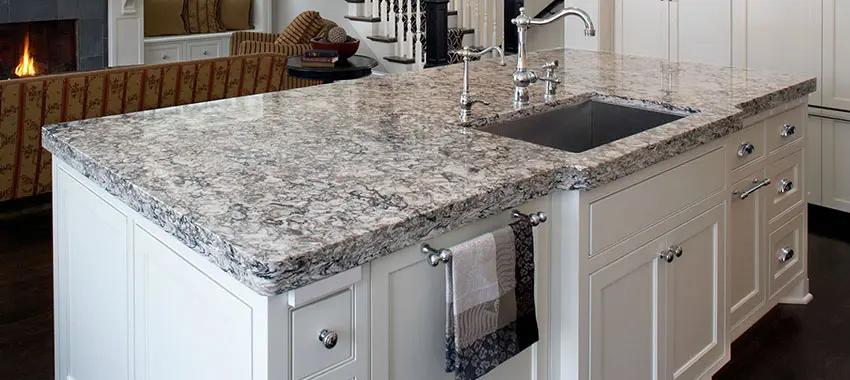
Granite Vs. Onyx Countertops: Durability Vs. Aesthetics
- 2026
- FlintStoneTops
Both granite and onyx are natural stones, but they have stark differences. Granite is the most popular natural stone countertop option, while onyx is considered a beautiful but costly and soft countertop material. So, if you’re considering a natural stone countertop for your kitchen, here’s a comparison between onyx and granite countertops.
Comparing Granite With Onyx Countertops
Composition
Let’s first know what they are made of.
Granite Countertops
Granite is formed deep inside the Earth’s surface. As magma cools and solidifies, it becomes granite. This is why granite is one of the hardest natural stones used for countertops. This process takes from thousands to millions of years so other materials like quartz, feldspar, and mica also become a part of it, creating unique patterns and veining.
Onyx Countertops
Onyx is formed near or in the path of spring water, as it’s the crystallization of the minerals (calcium carbonate) in spring water. As layers of minerals keep forming on one another, a uniquely beautiful and translucent rock is formed.
Appearance
Granite Countertops
Granite is usually associated with traditional and transitional kitchens, but its variety and unique patterns, speckles, and veining can improve the appearance of any kitchen. As it’s formed inside the Earth’s crust naturally, all the patterns are beautifully random, so no two granite slabs are alike. However, the patterns and veining are still subtle compared to onyx countertops.
Granite slabs can be found in a wide variety of colors, from dark to light and bright colors. There are variations of black, white, brown, green, red, and so many more shades.
With granite countertops, you have the option of many finishes as well. You can pick from glossy, matte, and leathered finishes. There is also the option of specialized finishes, such as brushed, flamed, etc.
Onyx Countertops
The appearance of onyx countertops is bold and loud. They have very dramatic patterns and waves compared to granite, that have subtle patterns and veining. You will find vivid and bright colors that instantly make the countertops the center of attention. Common hues of onyx countertops are green, orange, yellow, brown, pink, and others.
However, the factor that really makes onyx countertops unique is that they are translucent. Onyx is a transparent material and you can use it wonderfully with backlighting. Plus, the most common finish for onyx countertops is the high gloss finish, which is a cherry on top.
This is the reason onyx countertops are preferred when homeowners are looking for a statement piece that would be the focal point of the room. They are commonly preferred in high-end kitchens where appearance matters more than durability. Which brings us to the next point: comparing the durability of these two materials. However, more than a functional countertop in kitchens, onyx slabs are mostly used for accents and decoration.
Durability
Granite Countertops
As stated earlier, granite is one of the hardest materials used for countertops. It scores 6-7 on the Mohs hardness scale, so it doesn’t scratch or chip easily. This makes it a favorable option for everyday kitchens and bathrooms where the countertops need to be sturdy and don’t scratch too easily.
However, even though granite is a hard rock, you should not test its limits. Always use cutting boards when using knives or any other pointy stuff.
Onyx Countertops
When it comes to hardness and durability, onyx is similar to marble. It’s a soft material and scores 4-5 on the Mohs scale. So, it’s a softer and more delicate stone, and it can chip, scratch, and even crack pretty quickly. This means you have to be very careful with it.
Not only do you always have to chop everything on a cutting board, but you also have to avoid dragging any metallic item on the surface to avoid scratches.
Heat Resistance
Granite Countertops
Granite is a highly heat-resistant material, as it’s basically solidified magma. It can withstand very high temperatures, but if we only state the temperatures it can withstand without damage, they will be 300°F to 500°F (150°C to 260°C). So, you can put hot pans and other items directly from the stove or oven on the surface… but it’s still not recommended, though.
Even though granite is heat-resistant, it has a sealant applied over it for water-resistance. That sealant can get damaged with hot pans and, then, allows water into the surface, leading to stains. So, you should still use trivets and heat pads when placing any hot items on it.
The heat resistance is still beneficial because if you unintentionally put a hot pan directly on granite, it most probably won’t damage the surface.
Onyx Countertops
Onyx is a softer material and is not as heat-resistant. If you do want to use it as your primary kitchen countertop, always use trivets, coasters, and heat pads for putting hot items, because a single incident of a hot pan placed directly on the onyx counter may stain the surface. And you know, onyx countertops are all about appearance. If that’s affected, then they will look really bad. So, know the pros and cons of onyx countertops before buying.
Maintenance
Granite Countertops
Granite counters are low maintenance when compared to onyx countertops, even though both require sealing. Granite is a natural stone, so it’s porous, but as much as onyx. So, once sealed, the sealant can last for 1-3 years, depending on the usage.
In addition to that, granite is a sturdy rock, so you can clean it with a mild soap and a soft cloth. If you need a rugged and popular material that requires a medium level of maintenance, then granite would be a good choice.
Onyx Countertops
As already established, onyx is more porous than granite. This means it requires more frequent sealing. Usually, you have to seal it every 3 to 12 months. Even then, there’s a risk of the surface etching or staining due to spills. Even lemon drops can etch the surface. So, they require a lot of care to keep looking striking and beautiful.
When it comes to cleaning, you should not use any other cleaner than the one made for cleaning onyx surfaces. Anything else could be too abrasive or too bad for the material, which will lead to scratches and damage.
Longevity
Granite Countertops
As a natural stone, granite can last for a century, but in practical kitchens, a granite countertop should last up to 30 years at the very least. The longevity depends a lot on maintenance.
Onyx Countertops
It can also last a century, theoretically. However, as it’s more fragile, there is a higher risk of damage. Still, you can expect onyx countertops to last for 15 to 30 years. However, if you’re using it as the primary prep surface for a busy kitchen, the lifespan will be lower.
Cost
Granite Countertops
Granite is considerably cheaper than onyx. The starting price of granite countertops may be 50% lower than that of onyx countertops. It’s because granite is readily available almost all around the world.
Onyx Countertops
Onyx is more expensive than granite. Sometimes, 50% or more. This is due to the fact that onyx is rare compared to granite and is sourced only from a small number of countries.
Conclusion
Granite countertops are durable, beautiful, and cost-effective, and perfect for kitchen and bathroom countertops as the primary prep space. On the other hand, onyx is all about aesthetics. It’s bold and beautiful, but fragile and costly, so it’s suitable for high-end homes or for decorative purposes. Get in touch with a granite installer Rockville for samples.