
31

Mar

11 Misconceptions About Quartz Countertops

Quartz is a popular countertop option preferred for its durability and low maintenance. However, there are many things believed about quartz countertops that are not true at all. Here are some of the more ridiculous ones.

Myths About Quartz Countertops

Quartz countertops need to be sealed

For people familiar with quartz countertops, this one is outrageous because quartz is non-porous and doesn’t require sealing. This is one of the primary reasons why quartz worktops are so popular.

The myth stems from the perception that all countertop surfaces need to be sealed, which isn’t true. No man-made countertop option requires sealing, and quartz is also one of those. This makes quartz a low-maintenance option compared to natural stones, such as granite and marble, which do require regular sealing.

They are natural stone countertops

As most common countertop options are natural stones, many believe that quartz is also a natural stone, however, that’s far from the truth. The fact is that quartz countertops are made of crushed quartz crystals mixed with pigments and resin to form solid slabs. So, they are categorized as engineered stone countertops. People also call them man-made countertops.

What is natural quartz, though? Quartz is a crystalline mineral that’s found in most types of rocks. This quartz mineral is used in the manufacturing of quartz countertops. As it’s in a crystalline form, it’s crushed and then used with binders and resins.

Natural stones, on the other hand, are simply mined and then cut into slabs and fabricated.

Quartz and quartzite countertops are the same

The almost identical name of these two countertop options confuses a lot of people, and many think that they are the same. However, they are two very different countertop materials.

Quartz, in this context, is an engineered stone made with crushed quartz crystals and resins, whereas quartzite is a natural stone, a metamorphic rock formed beneath the Earth’s surface.

Quartz countertops have the characteristics of man-made materials, like they are non-porous and have a huge variety. On the other hand, quartzite countertops have natural stone properties, such as being porous and limited to their natural colors and patterns.

However, both are durable countertop options and their price range is also similar. But their installation costs differ, as quartz countertops cost less to install than quartzite.

Quartz countertops are for kitchens only

This is probably due to the fact that quartz countertops are commonly named and used in kitchens for countertop and island surfaces, so people associate them with kitchens only. But the real fact is that quartz countertops are suitable not only for kitchens, but also for bathrooms and laundry rooms, and they are suggested for home office desks, shower seats, fireplace surrounds, and many other purposes.

Quartz countertops are actually preferred in wet and moist areas like bathrooms and laundry rooms because they are non-porous, moisture-resistant, stain-resistant, and easy to clean. However, it’s better to avoid using them in areas that receive direct sunlight for most of the day. More on this in the next point.

They are not for outdoor kitchens

This one is partly true. Quartz countertops are not recommended for outdoor kitchens because they consist of resins and polymers that can discolor or warp if kept under direct sunlight for longer periods. So, quartz countertops will turn yellow or weaken outdoors. They are very much like sports cars that are excellent for highways but terrible for off-roads.

However, there are a few quartz countertop manufacturers who make UV-resistant quartz countertops that perform excellent outdoors as well. But they are not as commonly available and also cost more than regular quartz countertops. So, if you want a countertop option for your outdoor kitchen, it’s better to go with granite, concrete, stainless steel, or porcelain slab countertops.

Quartz countertops are expensive

Quartz counters can be budget-friendly or costly, depending on the quality you choose, along with the thickness and edge profile. In general, quartz countertops are mid-range countertop options with premium options available as well. Their pricing is quite similar to granite countertops, as they are also mid to high-tier countertops.

In comparison, quartz countertops usually cost less than marble, quartzite, stainless steel, and some types of wood countertops. On the other hand, they are costlier than laminate, ceramic tile, solid surface (Corian), and cheaper wood types.

Quartz countertops are high maintenance

A common misconception about quartz worktops is that they are high maintenance, but this is not true. In fact, they are one of the most low-maintenance countertop options because, unlike natural stones, they don’t require sealing and polishing. Moreover, their non-porous surface is stain-resistant, so there is a lower risk of them staining. So, caring for quartz countertops is easy. However, you do need to protect them from heat and abrasive cleaners.

They are heat-proof

Quartz countertops are fairly heat-resistant, but they are not heat-proof. In fact, they have lower heat resistance compared to natural stones like granite, marble, soapstone, and quartzite, and also other materials like stainless steel and concrete. However, they are better in heat resistance than laminate countertops.

Generally, they can withstand heat up to 150°F to 200°F (65°C to 93°C). Anything over can cause discoloration, heat stains, and cracks. So, you should always place hot pans and other items on trivets and coasters, otherwise, the surface will get damaged very quickly. Interestingly, this advice is for almost all countertop options, even natural stones that are highly heat resistant.

Quartz countertops scratch easily

This is not true because quartz slabs are scratch-resistant as they have a rating of 7 on the Mohs scale. So, they resist everyday scratches of knives and regular sharp objects. However, they are not scratch-proof. They can be scratched by abrasive tools, dragging metal objects on the surface, and also excessive use of knives can leave marks over time.

So, even though they are scratch-resistant, you should never chop food directly on the surface or they will slowly lose their appeal.

They are only available in white, gray, and light colors

Although white, gray, and light tones are popular quartz countertop colors, there is a huge variety of other colors as well you can choose. The thing is, quartz countertops are engineered stone slabs, so their color options are not limited to what nature offers. In fact, the use of polymers and resins allow manufacturers to make quartz slabs virtually in any color and pattern.

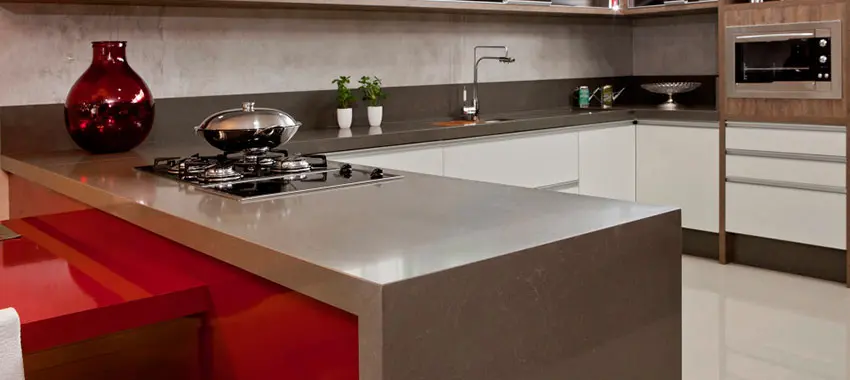
This means, apart from whites, grays, and light colors, you can also find darker colors, bright colors, and also unique ones like orange, green, and red.

Quartz countertops are only for modern kitchens

People associate quartz countertops with modern and contemporary kitchens because they add that sleekness required in those kinds of spaces. However, the wide variety of quartz countertop colors, patterns, finishes, and edging profiles allow you to choose them for any kitchen style and theme, be it traditional, transitional, modern, farmhouse, or even industrial.

Conclusion

Many of the misconceptions about quartz worktops can keep people from buying them or influence some to buy them for the wrong reasons. So, know these myths about quartz countertops before making any decision and consult a quartz countertop installer Rockville for credible information and quartz samples.
23

Dec

Pros And Cons Of Waterfall Quartz Countertops

There are many quartz countertop styles and edging profiles, and while some are minimal, others are extremely extravagant. Waterfall countertops are a blend of the two. They are extravagant but still look sleek and modern. So, here is everything you need to know about them this style or edging profile of quartz kitchen countertops.

What Are Waterfall Quartz Countertops?

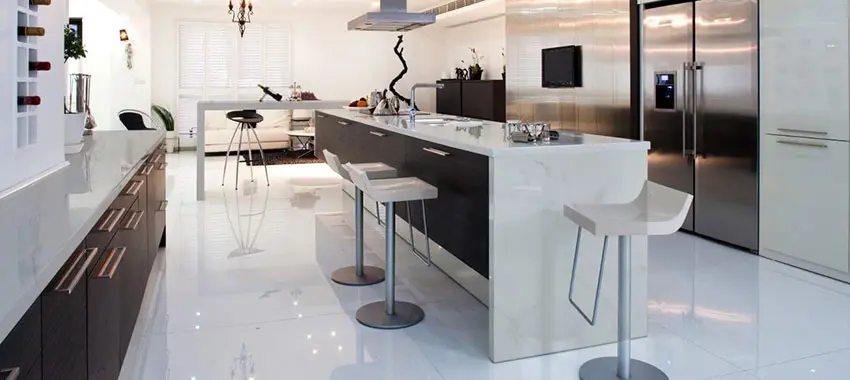
Waterfall countertop edging profile is really beautiful to look at. Basically, regular countertops end at the top of the counter surface. They can sometimes be protruded outwards, but that is pretty much it. Now imagine this protrusion going all the way down the countertop height. This is a waterfall countertop edge design.

It is basically the waterfall effect of the countertop material and it covers almost the entire countertop height. It can either be on one side, forming an L-shaped design, or it can cover both sides of the kitchen island, if they’re designed that way, giving the island a U-shape look.

This countertop edge design is a really classy way of making your countertops look unique and out of this world. This is really going to make the countertops look so chic and stylish that you’ll want this edge design on all of your countertops from this point on. The look of the waterfall is very continuous and it makes for a seamless design, which is perfect for people who want the material and its beauty to be on full display.

Pros Of Waterfall Quartz Countertops

So, now that you know what waterfall quartz countertops are and how they look, the next thing to go over is the qualities of this specific countertop design. So, here are some of the things that will make you want to get these countertops right this instant.

Very Elegant

If you don’t love the discontinuous look of regular quartz countertops that just end at the top, then waterfall countertops will steal your heart. This countertop edge design ensures that all you see is the beautiful material. It looks very elegant and stylish, but in a very understated way too, which is something that a lot of people love. And then there are many waterfall countertop ideas you can get inspiration from.

If you have a really beautiful quartz pattern and you want it to be the center of attention at all times, then this edge design will always put the spotlight on the pattern and the way it flows down.

Protect The Counters

If you have really fragile countertop bases or if they look just old and you don’t want them to be out in the open, then you can go ahead and cover the entire countertop base with this edge design.

It will be a win-win for you because you will be able to protect or cover the counter base and you will have a beautiful quartz slab draped over the base of the countertop and it will look like a dream. So, you don’t need to change the counter base when you follow the waterfall countertop tend.

Give A Cohesive Look

If you hate seams in countertops, which a lot of people do, then you will love the waterfall quartz countertop edge design. It is a very continuous and cohesive design and it literally looks like a waterfall of the material without any seams.

This might not be a huge issue, but for some, seams can really ruin the whole look of the countertops and sometimes, some materials shine the best when there are zero seams. Although, you can get a seamless installation without the waterfall design as well, but this design is a cherry on top.

Can Be Very Attractive

Waterfall countertops are adored by everyone out there. You can’t find one person who will find this countertop edge design too much. Because of the design of the edge and the overall softness of the material, waterfall countertops don’t look overpowering, which adds to the charm and appeal. So, if you love these kinds of unique edges and you want other people to bask in the beauty of this edge design, then it will be a treat for the eyes.

Quartz Is Excellent For Waterfall Edges

Not every material is good for the waterfall edge design, but quartz is one of the best options. This is because you can ensure a consistent pattern and seamless design, and it’s also low-maintenance compared to many countertop materials.

Other options that are good for a waterfall edging profile are granite, quartzite, sintered stone, porcelain slabs, and others. Some that you should avoid are tiles, wood, and laminate.

Cons Of Waterfall Quartz Countertops

Waterfall countertops sound like a dream, but they can also turn into a nightmare really quickly. So, here are some of the things about these very countertops that will make you want to think twice before getting them.

Hard To Craft

The waterfall edge design is beautiful and all that, and even though it might look really easy to craft and install, but it’s actually quite the opposite. Getting that perfect curve to create the waterfall shape and effect can take some time and effort. There are specific fabricators for the job and if they can’t get the job done, then no one can.

So, this countertop design is a labor of love and it really shows in the way it is made and the way it drapes over the counters.

They Are Expensive

You see a sleek and uniform countertop surface with a waterfall design, so this won’t come as a surprise that these countertops will run very expensive. This is something that is a huge bummer for a lot of people. They definitely love the edge design and all that, but when it comes to the price, it can make them stop and rethink their decisions

Also, there is more quartz used in this specific countertop design. You’re practically using another slab of quartz vertically as well. So, it will obviously cost you a lot more, especially if you end up using high-quality quartz.

There Are Hindrances

There are many things that you put on top of the counters and some of them are appliances that are powered by electricity and need outlets nearby. Well, with the waterfall countertop edge design, installing outlets can actually be impossible, because the very waterfall shape that everyone knows and loves can be an obstacle for the outlets and the wires of the appliances.

So, the waterfall countertop edge is not exactly the most practical edge design to get if this is an afterthought and the kitchen layout, appliance placement, and electrical outlets are not planned accordingly.

Conclusion

Waterfall quartz countertops are amazing, but they do have their own areas of lacking and that is something this guide will give you a lot of clarity on. If you want to go ahead and get this edging profile, then make sure to hire a skilled quartz countertop installer Rockville for a seamless and sleek countertop.

29

Oct

Grades Of Quartz Countertops & How To Examine A Quartz Sample

Quartz is a man-made countertop material and it’s one of the strongest available, offering excellent longevity and strength. However, when buying quartz kitchen countertops, you should learn about different grades of quartz and how to spot a fake or low-quality quartz slab. Here’s a guide.

Different Grades Of Quartz Countertops

Quartz countertops mainly have three grades. Let’s go through them one by one.

First-Choice Quartz

First-choice quartz is also known as high-grade quartz and it is the best grade of quartz out there, albeit very expensive at that. This grade has a very striking color that makes it look high-quality and it has the perfect thickness for kitchen slabs. The material concentration is definitely higher in first-grade quartz, making it heavier and sturdier, however, it also means that it will be a pain to install.

First-grade quartz is also highly scratch-resistant, so you don’t need to keep your knives at bay, because this can take on everything. But it’s not suggested to cut food directly on the surface without a trivet or coaster.

Second-Choice Quartz

This is the perfect middle material to choose from, if you don’t want to go for too expensive or too cheap quartz slabs. Also known as mid-grade quartz, second-choice quartz is stronger than its low-quality counterpart.

Unsurprisingly, it is popular among homeowners, because it’s really affordable, it comes in a lot of colors, and it’s fairly durable. But is it the most durable quartz quality on the planet? No. But that doesn’t mean you can’t get it for yourself. It will last a decent time in the kitchen.

Third-Choice Quartz

Also known as low-grade quartz, this material has more resin than quartz and minerals. This makes the material lightweight and affordable, but it is definitely not as long-lasting or durable as the above two grades.

However, you can still install it in your kitchen. You just need to be really careful that you’re not letting any hot things near it, because the resin will blister and it will lead to heat stains on the countertops, which is not what you want.

How To Check A Quartz Sample?

So now that you know the different grades of quartz countertops, you should learn how to check the quality of quartz as you can’t carry out extreme quartz durability tests. Here is what to look for when examining a quartz sample:

Check The Slab Thickness

The first thing you want to take note of is the slab thickness. Even though quartz comes in a lot of slab sizes, you still want to keep your eyes peeled for any sketchy signs.

So, when you’re looking at a slab, you first want to ensure that it obviously matches your dimensions, but if you want to see whether you’re getting a good quality quartz or not, then you have to check its thickness. The thickness should be uniform from any side. So, check the thickness from the middle and the edges and sides to see if there are variations. If there are, you’re looking at a low-quality quartz slab.

Moreover, the slab should be at least 2cm in thickness. Lesser thickness than that doesn’t necessarily mean the quartz slab is low-quality, but even first-choice quartz would be fragile at a thickness less than 2cm.

The Color Of The Slab

The next thing you want to consider is the color of the quartz slab. By now, you know that good quality quartz has a very potent color too. You don’t want to go for too white slabs because they look fake and may be of bad quality.

You also want to check whether the color and pattern is consistent throughout the slab. If you see any inconsistencies in the slab’s color or random yellow or black spots or pinholes, then you may want to stay away from that because it may be faux quartz or low-quality quartz.

Resin To Mineral Ratio

The next thing you want to check is the resin to mineral ratio. Even though quartz is primarily made out of resin and pulverized minerals, you still have to check how that ratio is running throughout the slab.

Firstly, you want to check if the slab is too yellow or not. If it is too yellow and very hard and brittle, then it has more resin than mineral in it. If it’s the other way around, then it is a good quality material. For reference, quartz slabs are usually 90-95% quartz and other minerals, and 5-10% resin.

The Price Tells A Lot

Quartz countertops, even though they’re man-made, can still run a little expensive, especially if they’re good quality. These countertops are nowhere near considered cheap by any means.

So, if you’re going for a good quality quartz countertop and you want to ensure that you’re not getting duped, then you have to buy it at full price. It might not be something you want to hear, but in the case of quartz, you’re paying for the quality you get. So, even though you might want to go the other way, it won’t be beneficial.

Weight Of The Quartz Slab

Quartz is also quite heavy. It is not a lightweight material by any means. If you pick up a sample of the quartz slab and try to get a feel of the weight, and if it feels slightly heavy, then you’re getting a good quality one. It means that it has the right ratio of mineral and resin.

If the quartz has too much resin in it or if it’s made out of non-quartz materials, then it will be lightweight. So, this is something that you have to keep in mind.

Is The Surface Smooth Or Gritty?

For this, you might need a magnifying glass, or you need to have a really good sense of detail. You want to check the grittiness of quartz. It is something that will save you from getting duped. Sometimes, people will make glass look like quartz and if that is the case, then the surface, especially where the veining is, will be very smooth.

Real, good-quality quartz, on the other hand, will be gritty with a texture. You can easily figure it out with a magnifying glass or by running your fingers over the material. It is a great way to figure out which is the real deal.

Where Is The Slab From?

You want to know the origin of the slab and this doesn’t just mean checking the label, which says where it’s made. These can be pretty misleading and, in all honesty, how hard is it to slap a label on something? So, if you want to ensure that you’re getting good quality quartz, then try to source your material from retailers that are known to source materials from countries that export quartz. This is also a really good tip for natural stone countertops.

Even though quartz is man-made, some countries specialize in manufacturing them. Top countries that export quartz are China, India, USA, Turkey, Brazil, and Norway.

Conclusion

Quartz grades may seem like they are insignificant, but you’ll only know the difference when you get your hands on the good quality stuff. Hire a reputable quartz countertop installer Rockville who can help you navigate through the entire quartz countertop installation process from choosing the quartz quality to the installation.

27

Jul

Quartz Vs Quartzite Countertops: How Are They Different?

There are a number of countertop materials you can choose from and deciding which one to go for can be nothing less than a hassle. You’re in luck because this comparison between quartzite and quartz kitchen countertops will make the selection a piece of cake for you.

Differences Between Quartz And Quartzite Countertops

Composition

Quartz Countertops

Quartz is actually a man-made material. It is made up of pulverized quartz crystals with sand and it’s mixed up with resin to create a hard slab that is a perfect choice for your kitchen if you’re looking for something beautiful and durable.

This countertop material is available in tile form as well as slab form, but slabs are preferred more by people. Because it’s more durable, have a nicer and elegant appearance, and can give your kitchen that flair of character. Quartz is one of the most versatile man-made materials and it is definitely a winner in the kitchen.

Quartzite Countertops

Quartzite is a natural stone so it does have a majestic appearance as granite and marble does. It is made up of quartz, mostly, but some variants might also have mica and some percentage of sand as well.

Quartzite has a beautiful and subtle appearance as well because it has an array of veins going all over its surface in different directions. It has a light base, and the top is decorated with light and dark veining that looks absolutely breathtaking in different lighting.

If you’re looking for a natural countertop material that’s going to be a statement in your kitchen, but don’t want to spend a lot on options like granite and marble, then quartzite is the way to go.

Durability

As far as durability is concerned, both quartz and quartzite are up there.

Quartz Countertops

Quartz, since it is a man-made material, is going to be extra durable and strong, as compared to its natural counterparts. It is compacted under high pressure and there is reinforced strength that makes this material a much better option.

The material doesn’t shatter or crack under high pressure or under forceful impacts and it’s going to last a lot longer, especially if you take care of them properly. It is also quite heat resistant.

Quartzite Countertops

Quartzite might seem like a less durable option out of the two, but it doesn’t mean that it’s a fragile material. It is considered to be even harder than granite, even though both are natural and porous rocks.

Quartzite is quite comparable in strength with quartz, but if you really want to get down to the nitty-gritty, then a better and more durable option would be quartz because it’s low on the maintenance side of things on top of being strong. It is also one of the very few natural stones that have built-in UV protection so the color doesn’t fade over time and it also keeps the surface free from germs.

Cost

Price is another important factor to consider when buying a countertop material for your kitchen. A lot of people tend to opt for materials that are reasonably priced because they don’t want to spend so much on countertops.

Quartz Countertops

Quartz is available in a huge variety, but the price solely depends on the retailer, the thickness of the slab you’re choosing, and the overall quality of quartz.

A one-square-foot slab of quartz will cost you anywhere between $60 to $70, which is quite reasonable for a durable and strong countertop material.

Quartzite Countertops

Quartzite is a natural stone and although the stone itself doesn’t cost a lot, there are overhead costs that might make it an expensive choice. This material isn’t as expensive as other natural stones like granite and marble, so it’s still a reasonably priced material as far as natural stones are concerned.

Quartzite will cost you around $70 to $80 including additional things like sealing and polishing, for a slab. It  is pretty heavy and the installation cost of this material is also insanely high, from $200 to $300 so a lot of people tend to go for DIY countertop installation.

Maintenance

Quartz Countertops

Quartz is a very low-maintenance material. There is no need to seal it. You can clean it very easily and it is heat resistant as well. Even though quartz is quite durable, that still doesn’t mean that it can’t get damaged by heat. It’s better to take care of the countertops as much as you can because heat can ruin the look of quartz countertops and it can lead to heat stains if you constantly put the countertops in contact with heat.

Even though you can get away with a few times, it’s better to take good care of these countertops, so that their maintenance doesn’t become a hassle for you in the future.

Quartzite Countertops

Quartzite, since it is a natural stone, needs to be sealed because it is porous and any contact with water, moisture, and even certain foods can lead to permanent stains on the countertop. Because quartzite is also quite light in color, the appearance of stains can be very obvious and the surface can look very dirty.

Sealing the countertops will ensure that your countertops stay in good condition for long. But it is still an extra step and you’ll need to reseal the countertops every year to freshen up the look of the countertops.

Stain Resistance

Quartz Countertops

Quartz is a non-porous material, so it is naturally stain-resistant, especially when it comes to things like food and water stains. Being virtually non-porous and highly dense, quartz will last a lot longer than most materials and it also won’t get damaged as easily from moisture or mold formation.

The only real culprit that can damage and ruin the look of quartz is sunlight. Quartz isn’t resistant to UV rays, so the color can fade over time.

Quartzite Countertops

Quartzite, on the other hand, isn’t stain resistant without the extra help of a sealant. Sealing quartzite countertops is considered to be an extra step towards protecting the stone from severe damage and bacterial infestations.

Some people can be wary of sealing these countertops because it’s extra work and expense, but it’s going to go a long way.

Variety In Colors

Lastly, the variety in colors and designs is something that can be a deal maker or breaker for a lot of people. Nothing is more off-putting than having a seemingly perfect countertop material, but not having enough color options according to your liking.

Quartz Countertops

Quartz is very forgiving when it comes to color selection. There are light, dark, and bright colors available in this material and you can get just about any color in quartz countertops.

Quartzite Countertops

Quartzite lacks the variety of colors that quartz has. The former material is only available in a range of neutral and light colors, which isn’t usually an issue for people who prefer lighter-colored countertops. However, light colors can be a pain in the neck to maintain since they can get dirty and murky pretty quickly. This is why a lot of people choose darker countertop colors.

Conclusion

This comparison covers everything from durability to price and whatnot. Now, keeping these things in mind about both countertop materials, you can make the choice for your kitchen. Whichever material you choose, hire a quartz countertop installer Rockville to flawlessly install the countertop in your kitchen.