
Apr
Why Are Quartz Countertops So Popular? Top 8 Reasons
- 2026
- FlintStoneTops
When considering countertop options, a lot of homeowners and experts alike suggest quartz countertops. So, if you’re wondering why they are so popular and if they would be the right option for your kitchen, follow this guide.
Reasons Why Quartz Countertops Are Popular
They Are Highly Durable
Quartz countertops are made with 90-95% crushed quartz crystals and resin and polymer. They are engineered stone countertops and considered one of the most durable engineered countertop options out there.
This statement holds a lot of weight when you compare the hardness of quartz countertops with other popular options, like granite and marble. Quartz countertops score 7 on Mohs hardness scale while granite scores 6-7 and marble 3-4. So, this man-made stone is equal or better in hardness (scratch-resistance and durability) than granite, a popular natural stone option.
This turns heads and makes people consider this option. But that’s not the only reason people choose quartz. There are more reasons, as well explained in this guide.
Quartz Countertops Are Non-Porous Surfaces
So, quartz is more scratch-resistant and harder than granite? So what? Well, here’s an even better reason why quartz is popular. Quartz countertops are non-porous, which means any spills won’t seep into the surface and cause stains or hygiene concerns.
As spills are inevitable in kitchens, you need a surface that doesn’t stain or appear ugly after a spill. Quartz checks this box. One that almost all natural stones can’t because natural stones, like granite, marble, soapstone, quartzite, etc., are porous and allow water to be absorbed into the surface. This is why natural stone countertops are always sealed.
So, what about other engineered surfaces? They may be non-porous as well? You may ask. The answer is: yes, most synthetic or man-made countertop surfaces are non-porous. Popular ones include solid surface, laminate, and others. But what they don’t have is the kind of durability that quartz possesses.
Therefore, in that, quartz has the best quality of natural stones (durability) without the drawback of porosity, and it also has the best quality of engineered options (non-porous surface) without the drawback of lower durability.
They Don’t Require Sealing
This ties in with the above point. As quartz countertops are non-porous, they don’t require sealing. Natural stones require sealing every year or so. And as you apply a sealer to the surface, you have to care for the slab more mindfully. Because even if you have a durable countertop, like granite, the sealer is still not as scratch-resistant or heat-resistant as the granite’s surface. So, you will have to use protection, like cutting boards, trivets, and coasters. This applies to all natural stones.
Now, you do still need to use cutting boards, trivets, and coasters for quartz countertops as well, but they are more forgiving if you seldomly chop a food item directly on the surface. However, heat resistance is a whole another issue. You must use trivets and heating pads, otherwise, the surface may get heat stains or damage.
Design Versatility
Quartz countertops are manufactured in factories. This means that their design and colors can be controlled and made in as many variations as you can think of. So, you can find all kinds of quartz colors and patterns that will match perfectly with your kitchen’s color theme and style.
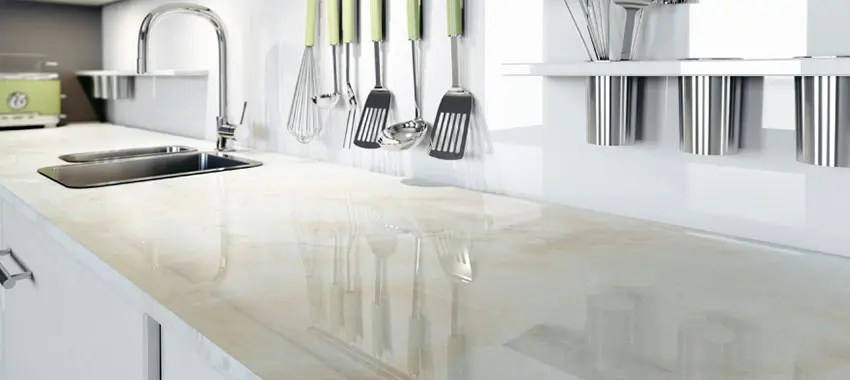
Moreover, quartz countertops can be made to look like natural stones, like granite or marble. This means you can get a surface that appears like natural stone without their drawback (porosity). This is a huge win for many people.
But some people may say that laminate and solid surface countertops can also mimic natural stones, so why are quartz surfaces popular? Well, because laminate countertops use sheets that have the print of natural stone, they don’t appear very real if someone looks closely.
On the other hand, solid surface countertops are softer and lighter, so they don’t have the heaviness associated with natural stones. Not to mention that both surfaces are not as durable as most natural stones and quartz countertops.
As quartz surfaces are as hard as some of the best natural stones, they take the cake for being the most preferred choice among engineered countertops that can imitate the look of natural stones.
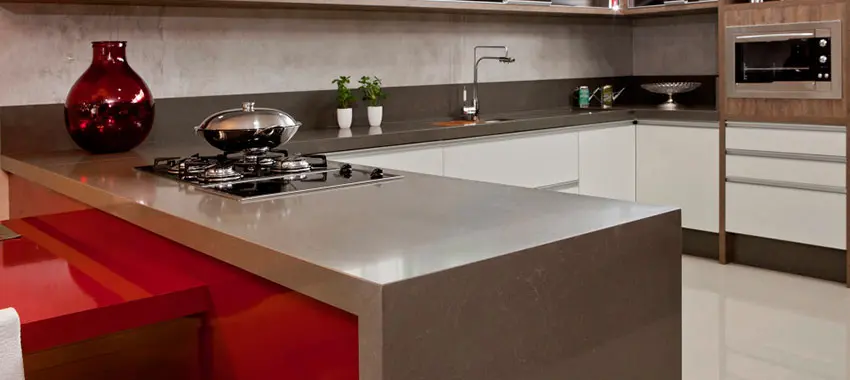
However, keep in mind that this is not the only benefit of quartz countertops when it comes to appearance. Quartz surfaces have come a long way and they have many color, veining, and pattern options that can’t be found in natural stones. Many people also prefer solid color quartz countertops for a modern and sleek look.
In short, they are popular because the design versatility allows homeowners to use them in any style of kitchen, be it traditional, transitional, or modern. This is why quartz countertops are all over the latest kitchen trends.
Quartz Countertops Are Low Maintenance
Quartz countertops are low-maintenance because they don’t require sealing, and cleaning them is super easy. All you need is a mild detergent and water to wipe the surface.
Moreover, due to the non-porosity, there is a lower risk of stains from spills, so you don’t need to clean them intensively to remove stains. That’s a common problem with natural stones. However, remember that quartz countertops are not very heat-resistant, so heat stains can occur if you’re not being careful and not using trivets and coasters.
When compared to engineered materials, like laminate and solid surface, all these surfaces are low maintenance and don’t need sealing. However, quartz countertops have excellent scratch-resistance and durability that laminate and solid surface don’t have.
Moreover, concrete and paper composite are durable man-made countertop options, but they do require sealing. And then there are stainless steel countertops that are also easy to clean and are durable, and are the norm in commercial kitchens, but they are not much preferred in residential kitchens.
Scratches Can Be Fixed Easily
Not all countertop surfaces allow you to fix scratches, and the process can be difficult. There are materials like laminate, butcher block, recycled glass, stainless steel, concrete, porcelain, and others that can be hard to fix when scratched.
So, easier reparability of quartz countertops is a huge benefit. You can have minor scratches buffed, and for deep scratches, you can apply epoxy fillers. However, if the scratches are real ugly, you will need a professional’s help.
The Cost Range Of Quartz Countertops
Quartz countertops are not very affordable and more expensive than options like laminate and solid surface, wood, and recycled surfaces, but they are still a good option, as quartz counters are more durable than cheaper options.
Moreover, the cost range of quartz countertops is similar to that of granite countertops, while they are actually cheaper than marble, quartzite, and many others.
They Boost Home Value
Quartz countertops are popular due to the above-mentioned reasons, so buyers perceive the property as more attractive. This increases the home’s value and helps you fetch a better price.
Downsides Of Quartz Countertops
Quartz countertops have many benefits, but they do have a few downsides you should know before buying:
- Direct sunlight can fade the material, so they are not suggested for outdoor kitchens.
- They are not heat-resistant. Therefore, always use trivets and heating pads.
- High-end quartz surfaces can be expensive.
Conclusion
Quartz countertops are popular because they are durable, scratch-resistant, non-porous, low-maintenance, and have a lot of variety. If you want to know more or want to take a look at samples, get in touch with a quartz countertop contractor Potomac.