

31

Mar

11 Misconceptions About Quartz Countertops

Quartz is a popular countertop option preferred for its durability and low maintenance. However, there are many things believed about quartz countertops that are not true at all. Here are some of the more ridiculous ones.

Myths About Quartz Countertops

Quartz countertops need to be sealed

For people familiar with quartz countertops, this one is outrageous because quartz is non-porous and doesn’t require sealing. This is one of the primary reasons why quartz worktops are so popular.

The myth stems from the perception that all countertop surfaces need to be sealed, which isn’t true. No man-made countertop option requires sealing, and quartz is also one of those. This makes quartz a low-maintenance option compared to natural stones, such as granite and marble, which do require regular sealing.

They are natural stone countertops

As most common countertop options are natural stones, many believe that quartz is also a natural stone, however, that’s far from the truth. The fact is that quartz countertops are made of crushed quartz crystals mixed with pigments and resin to form solid slabs. So, they are categorized as engineered stone countertops. People also call them man-made countertops.

What is natural quartz, though? Quartz is a crystalline mineral that’s found in most types of rocks. This quartz mineral is used in the manufacturing of quartz countertops. As it’s in a crystalline form, it’s crushed and then used with binders and resins.

Natural stones, on the other hand, are simply mined and then cut into slabs and fabricated.

Quartz and quartzite countertops are the same

The almost identical name of these two countertop options confuses a lot of people, and many think that they are the same. However, they are two very different countertop materials.

Quartz, in this context, is an engineered stone made with crushed quartz crystals and resins, whereas quartzite is a natural stone, a metamorphic rock formed beneath the Earth’s surface.

Quartz countertops have the characteristics of man-made materials, like they are non-porous and have a huge variety. On the other hand, quartzite countertops have natural stone properties, such as being porous and limited to their natural colors and patterns.

However, both are durable countertop options and their price range is also similar. But their installation costs differ, as quartz countertops cost less to install than quartzite.

Quartz countertops are for kitchens only

This is probably due to the fact that quartz countertops are commonly named and used in kitchens for countertop and island surfaces, so people associate them with kitchens only. But the real fact is that quartz countertops are suitable not only for kitchens, but also for bathrooms and laundry rooms, and they are suggested for home office desks, shower seats, fireplace surrounds, and many other purposes.

Quartz countertops are actually preferred in wet and moist areas like bathrooms and laundry rooms because they are non-porous, moisture-resistant, stain-resistant, and easy to clean. However, it’s better to avoid using them in areas that receive direct sunlight for most of the day. More on this in the next point.

They are not for outdoor kitchens

This one is partly true. Quartz countertops are not recommended for outdoor kitchens because they consist of resins and polymers that can discolor or warp if kept under direct sunlight for longer periods. So, quartz countertops will turn yellow or weaken outdoors. They are very much like sports cars that are excellent for highways but terrible for off-roads.

However, there are a few quartz countertop manufacturers who make UV-resistant quartz countertops that perform excellent outdoors as well. But they are not as commonly available and also cost more than regular quartz countertops. So, if you want a countertop option for your outdoor kitchen, it’s better to go with granite, concrete, stainless steel, or porcelain slab countertops.

Quartz countertops are expensive

Quartz counters can be budget-friendly or costly, depending on the quality you choose, along with the thickness and edge profile. In general, quartz countertops are mid-range countertop options with premium options available as well. Their pricing is quite similar to granite countertops, as they are also mid to high-tier countertops.

In comparison, quartz countertops usually cost less than marble, quartzite, stainless steel, and some types of wood countertops. On the other hand, they are costlier than laminate, ceramic tile, solid surface (Corian), and cheaper wood types.

Quartz countertops are high maintenance

A common misconception about quartz worktops is that they are high maintenance, but this is not true. In fact, they are one of the most low-maintenance countertop options because, unlike natural stones, they don’t require sealing and polishing. Moreover, their non-porous surface is stain-resistant, so there is a lower risk of them staining. So, caring for quartz countertops is easy. However, you do need to protect them from heat and abrasive cleaners.

They are heat-proof

Quartz countertops are fairly heat-resistant, but they are not heat-proof. In fact, they have lower heat resistance compared to natural stones like granite, marble, soapstone, and quartzite, and also other materials like stainless steel and concrete. However, they are better in heat resistance than laminate countertops.

Generally, they can withstand heat up to 150°F to 200°F (65°C to 93°C). Anything over can cause discoloration, heat stains, and cracks. So, you should always place hot pans and other items on trivets and coasters, otherwise, the surface will get damaged very quickly. Interestingly, this advice is for almost all countertop options, even natural stones that are highly heat resistant.

Quartz countertops scratch easily

This is not true because quartz slabs are scratch-resistant as they have a rating of 7 on the Mohs scale. So, they resist everyday scratches of knives and regular sharp objects. However, they are not scratch-proof. They can be scratched by abrasive tools, dragging metal objects on the surface, and also excessive use of knives can leave marks over time.

So, even though they are scratch-resistant, you should never chop food directly on the surface or they will slowly lose their appeal.

They are only available in white, gray, and light colors

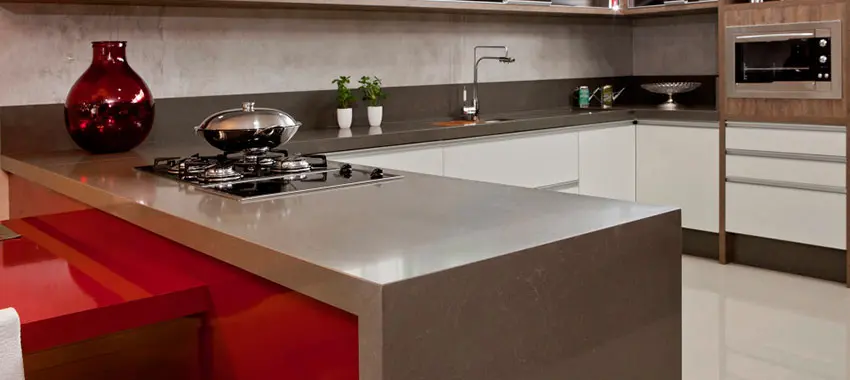
Although white, gray, and light tones are popular quartz countertop colors, there is a huge variety of other colors as well you can choose. The thing is, quartz countertops are engineered stone slabs, so their color options are not limited to what nature offers. In fact, the use of polymers and resins allow manufacturers to make quartz slabs virtually in any color and pattern.

This means, apart from whites, grays, and light colors, you can also find darker colors, bright colors, and also unique ones like orange, green, and red.

Quartz countertops are only for modern kitchens

People associate quartz countertops with modern and contemporary kitchens because they add that sleekness required in those kinds of spaces. However, the wide variety of quartz countertop colors, patterns, finishes, and edging profiles allow you to choose them for any kitchen style and theme, be it traditional, transitional, modern, farmhouse, or even industrial.

Conclusion

Many of the misconceptions about quartz worktops can keep people from buying them or influence some to buy them for the wrong reasons. So, know these myths about quartz countertops before making any decision and consult a quartz countertop installer Rockville for credible information and quartz samples.
14

Mar

7 Reasons To Avoid Concrete Countertops For Indoor Kitchens

Concrete is a durable building material, so wouldn’t it make for a durable and long-lasting countertop? Many people think that. And concrete countertops are, in fact, durable and excellent for outdoor kitchens, but for indoor kitchens, they may not be the best choice, even though they offer heat-resistance and customizations. Other options like granite or quartz countertops are much better indoors for a lot of reasons. Let’s know why.

Downsides of Concrete Countertops For Indoor Kitchens

Need To Be Sealed Frequently

Concrete countertops are porous, which means they can absorb liquids and spills. This creates multiple problems. A porous surface doesn’t only make cleaning difficult, but it also leads to stains in the long run because even when you clean the surface, some of the liquid will seep into the countertop, causing ugly stains.

This is why concrete countertops need to be sealed frequently, once every 1-2 years. If you have a busy kitchen, you may have to reseal concrete countertops every year. It’s critical to be cautious because sealers don’t have any color, so you wouldn’t clearly know when the sealer is breaking down. Therefore, you would want to seal it regularly to avoid stains and damage. But remember that granite and any natural stone countertop also require sealing.

The Heat-Resistance Is Of No Use

Let us explain why one of the best things about concrete countertops, heat resistance, is of no use. Concrete countertops are highly heat-resistant. However, they are porous and you always need the surface to be sealed. Now, the sealers you apply to concrete countertops aren’t heat-resistant, even though concrete is.

So, if you put hot pans or any other hot item on the concrete surface, it will break down the sealer. And you know what follows after that. Any spills will stain the surface and you don’t want that. Therefore, you will need to use trivets and coasters for concrete countertops to ensure the longevity of the sealer applied to the surface.

So, the heat resistance of concrete countertops is an attractive benefit for outdoor kitchens because you need a material to withstand direct sunlight or extreme temperatures without cracking, but it’s not as much for indoor kitchens.

But to be fair, heat resistance isn’t quite helpful whichever countertop material you choose. Even if you have quartz, granite, or any other countertop surface, it’s never recommended to put hot pans directly on the surface.

Hairline Cracks Are A Norm

Concrete is different from natural and engineered stones. As the concrete dries during curing, it shrinks a bit, which leads to hairline cracks on the surface. These cracks are not a durability concern and are considered a natural part of concrete finishing, but they affect the aesthetics, especially in indoor kitchens.

These hairline cracks are visible, though not too bad if you’re going for a rustic or industrial look. But if you need a surface that appears modern and sleek, these hairline cracks may be a problem.

Why is it not an issue for outdoor kitchens? Usually, outdoor kitchens are made of concrete blocks or stones and have stainless steel appliances, which makes for a rugged look, so hairline cracks of concrete countertops don’t look out of place.

Brittle Compared To Granite And Quartz Countertops

Concrete countertops have excellent compressive strength. You can place a huge amount of weight on them. But when it comes to tensile strength, it is a weak material. If hit by some force, they can crack much easily than granite or quartz countertops. So, concrete countertops are especially not recommended for kitchen islands and peninsulas with overhangs.

But why is that? In the case of these three materials, their tensile strength is roughly 10% of their compressive strength. Both granite and quartz have way higher compressive strength than concrete, so their tensile strength is higher as well.

Why is it not a concern outdoors? Because other benefits of concrete countertops for outdoor kitchens outweigh this drawback. For indoor kitchens, you have better options like quartz countertops, so this disadvantage of concrete counters sticks out.

You May Need Cabinet Reinforcement

Concrete countertops are heavier than granite or quartz countertops of standard thicknesses (2mm to 3mm), so you’ll most likely need to reinforce your kitchen cabinets to ensure that they have the load-bearing capacity for concrete slabs without sagging. So, the installation may cost even more due to the added requirement.

Why is this not an issue for outdoor kitchens? Outdoor kitchens are made to be sturdy and durable to withstand the outdoor elements. The cabinets are commonly made of stainless steel, marine grade aluminum, concrete, or HDPE (high-density polyethylene), which don’t need anything extra for concrete countertop installation. However, if the cabinets of your outdoor kitchen are made of wood or PVC, they will require reinforcement.

Not DIY-Friendly

Many people pitch concrete countertops as DIY-friendly and it’s understandable why they are perceived as that. You just need basic tools and have to mix and pour concrete into forms, finish, and wait for it to cure. Simple, right? Well, not so much.

Although pouring concrete countertops yourself can save you a significant amount of money, it’s not recommended unless you have prior skills dealing with concrete.

Firstly, there are many types of concrete and mixing concrete requires special skills, else the concrete would not be durable enough, even when you pour and finish it correctly. Now, you can avoid this whole problem by simply ordering ready-mixed concrete. But that’s still not it.

Even when you have an excellent concrete mix at your disposal, you still have to build molds, pour concrete, and finish and cure it. Any misstep in this will lead to an uneven surface, cracks, and durability issues. Plus, DIYing also rules out complex shapes and designs.

Therefore, to ensure durability and longevity, you will need professionals for pouring and installing concrete countertops.

Installation Is More Time-Consuming

Installing concrete countertops usually requires more time than natural stone or engineered stone options. This means you won’t be able to use your kitchen for a longer time. Let’s compare how much time a few options take:

Granite, Quartz, And Other Stone Countertops

Popular stone countertops like granite and quartz are quicker to install because the slabs are usually already there. After the measurements, the fabrication process begins, which can take from 3 to 14 days, depending on the stone. For instance, quartz fabrication takes 3-10 days while granite fabrication may take up to 14 days.

After fabrication, the installation is usually done within a few hours and the countertops are ready to use right after the installation. The entire process takes 1 to 2 weeks.

Precast Concrete Countertops

Precast concrete countertops are made according to the requirements in a workshop. This takes from 1 to 2 weeks. The fabricated concrete slabs are then installed in the kitchen. You can use the concrete surface about one week after the installation. The whole process takes 2 to 4 weeks.

Precast concrete countertops are preferred because they comparatively take less time to install than cast-in-place concrete countertops and there is less mess in the kitchen as well.

Cast-In-Place Concrete Countertops

They are poured on-site, in the kitchen, so you have more customization options and the slabs are seamless. However, they are more time-consuming to install than other options. Concrete is poured on the cabinets, which requires days to cure. After curing, drying and polishing needs further time. The entire process takes 3 to 4 weeks.

Why is this not an issue for outdoor kitchens? Because outdoor kitchens are not primary kitchens, you won’t mind the countertop installation taking more time. However, for indoor kitchens, you want the installation to be quick.

Conclusion

Concrete countertops are durable and heat-resistant and have many other benefits, but the above-mentioned points emphasize why they aren’t great for indoor kitchens. If you want a countertop option that offers durability, heat-resistance, low maintenance, and faster installation for your indoor kitchen, consider quartz countertops by consulting a quartz countertop contractor Potomac.