

Nov
16 FAQs About Choosing Quartz Countertops Thickness
- 2025
- FlintStoneTops
So, you’re choosing quartz countertops for your kitchen but haven’t really decided on the details like the color and pattern, the finish, the size, the thickness, and others? Well, this guide is all about choosing the thickness of quartz countertops, as we will answer the most frequently asked questions on the topic. Let’s begin!
Most-Asked Questions About Selecting Quartz Countertops Thickness
What is the standard thickness of quartz countertops?
The standard thickness of quartz countertops is 2 cm (3/4 inch) and 3 cm (1 1/4 inches). Quartz slabs 3 cm thick are common in kitchens, while 2 cm is often used for prefabricated slabs and bathroom countertops.
Is thicker quartz more expensive?
Yes, thicker slabs are costlier, whichever material you choose. Apart from the material’s cost, the installation cost may be higher as well for thicker quartz slabs as they are heavier and may require special tools and techniques for installation. Usually, 3 cm quartz slabs are considered thicker slabs and are commonly used in kitchens.
Is it better to have thick or thin countertops?
Short answers: For kitchens, a thick countertop (3 cm and over) is better than a thin (2 cm and below) countertop if your budget allows, as it’s more durable and won’t crack easily. For bathrooms, the same is true, but 2 cm slabs are considered thick, while anything lower than that is taken as thin.
Long answer: Thick quartz countertops are preferred for their higher durability and aesthetics, but they are usually costlier and heavier. They may require you to consider additional support for the cabinets. Moreover, thicker quartz slabs are good at noise reduction and enable you to entertain more customization options like detailed edging profiles, various sink designs, and other functional and stylistic improvements.
Thin quartz countertops are favored by people who want a cost-effective countertop installation and need a minimal and modern appearance. The installation is easier as you don’t need reinforcements for cabinets and the slabs are eco-friendly because they have a smaller carbon footprint.
However, the durability of quartz countertops reduces as you go for thinner slabs. So, 2 cm slabs are less durable than 3 cm slabs, while 1 cm slabs are less durable than 2 cm slabs, keeping the quartz quality constant. Moreover, thinner slabs may look cheaper at a glance and there are fewer customizations for thinner quartz slabs.
Is 2cm or 3cm quartz better?
For kitchen countertops, 2cm and 3cm are common thickness options for quartz slabs. 3cm is more durable, a standard for kitchen countertops, and offers more customization options and styles. On the other hand, 2cm slabs are more cost-effective, still fairly durable, and lighter. If budget is not an issue, 3cm quartz is always the better choice. However, if you want a cost-effective option, choose 2cm quartz slabs and use plywood support under the slabs.
For backsplashes and bathroom countertops, 2cm is a standard and you can choose it without worrying about durability issues.
What is the price difference between 2cm and 3cm quartz?
The price difference between 2cm and 3cm quartz is usually 20-30%, given that the quartz quality is the same. However, the standard for kitchens is 3cm slabs, but if you have a tight budget, you can choose 2cm slabs along with professional installation.
Can you make a thin countertop slab look thicker?
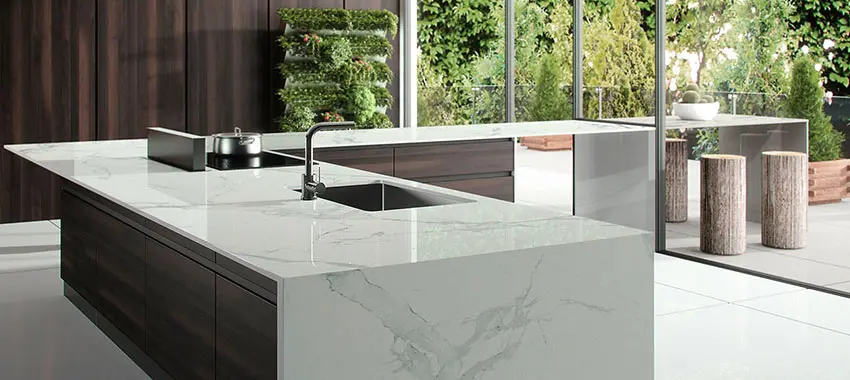
Yes, you can make a thin countertop slab appear thicker by choosing the right edging profile, like mitered, laminated, waterfall, and others. With these edging options, you can make a 2cm quartz slab look like 3cm or 4cm.
How to choose the thickness of your quartz countertop?
Firstly, you should know about common thicknesses for quartz countertops, which are 3cm and 2cm. The former is more durable and the latter is a bit less durable. Secondly, consider the budget as thicker slabs are obviously pricier than thinner slabs. You should also take some time to choose an edging profile, as there are many options and some can also create an illusion of a thicker countertop slab.
Moreover, consider the style of your kitchen because 2cm slabs work well with modern and minimalist kitchens, while 3cm quartz slabs are for traditional and luxury kitchens. On than that, choose a thickness by keeping in mind your usage because busy, high-traffic kitchens are better off with 3cm slabs.
Do 2cm quartz slabs need plywood support?
Yes, you need to install a plywood support underneath the quartz slab and then install the slab. This adds support, allows for overhangs, and reduces the risk of the slab cracking during installation or due to a sudden impact.
Are thin countertops in style?
Yes, thin countertops are commonly used in modern and contemporary kitchens as they add a sense of sophistication and sleekness. However, 2cm slabs are usually considered thin, whereas the standard for traditional and high-end kitchens is 3cm.
Do thicker quartz countertops boost the home value?
Thicker quartz countertops (3cm and over) are considered high-quality and durable, so they can have a positive impact on the home’s value if all other factors favor it, such as the quality of quartz, your home’s design and aesthetics, the countertop thickness standard in your neighborhood, and the condition of the countertops.
If the quartz quality is mediocre, the home’s design doesn’t complement a thicker slab, thinner counters are favored in your neighborhood, or the countertops are faded, then a thicker slab won’t be of any help.
How thick is 2cm quartz?
A 2cm quartz slab is 3/4 inch or 20mm. It’s considered a thin quartz slab best for bathroom vanities, vertical installations, and budget-friendly kitchen countertops.
A thicker low-quality quartz slab vs. a thinner high-quality quartz?
When comparing a 3cm low-quality quartz slab with a 2cm high-quality quartz slab, quality matters more than thickness. Therefore, a 2cm high-quality quartz slab would be a better option in terms of durability and longevity. Keep in mind that if the quality is the same, a thicker slab is better than a thinner slab.
How far can a 2cm quartz overhang?
Unsupported overhang of a 2cm quartz countertop can be 6-8 inches. However, if you add support every 24-30 inches, you can extend the overhang to 12 inches. Without proper planning, longer overhangs can crack, so have an expert install the countertop.
Can you mix countertop thicknesses?
Yes, you can use two different thicknesses for countertops in the same kitchen. You can do so by picking a thicker slab for the island while using a thinner slab for the countertops. This can help you create a focal point in the kitchen or a stylistic statement and also help you save money.
How thick should a quartz kitchen island surface be?
Your quartz kitchen island surface should be 3cm for durability and aesthetics. However, you can get away with a 2cm surface if you use high-quality quartz and install plywood under the quartz slab.
Is 1.5cm quartz too thin?
For kitchen countertops, 1.5cm quartz is too thin. The standard thickness for quartz and natural stones is 3cm, however, you can go with 2cm as well. On the other hand, you can use 1.5cm for bathroom vanities or vertical applications such as backsplashes.
Conclusion
The durability of your quartz countertop depends on the quality and the thickness of the slab. So, choose thickness carefully. Get in touch with a quartz countertop contractor Rockville for advice and countertop installation.