

28

Jan

What Are Flamed Granite Countertops? Pros And Cons

One of the most sought-after materials for kitchens are granite countertops. And for a good reason. They’re durable, they’re amazing to look at, and they are available in a variety of price ranges. So, what is a flamed granite countertop? It’s one of types of granite finishes. Let’s know everything about it.

What Is Flamed Granite Finish?

Flamed granite is a very unique finish of the well-loved granite countertops. You have heard of honed, glossy, and leathered finishes, but flamed might be something you haven’t heard of.

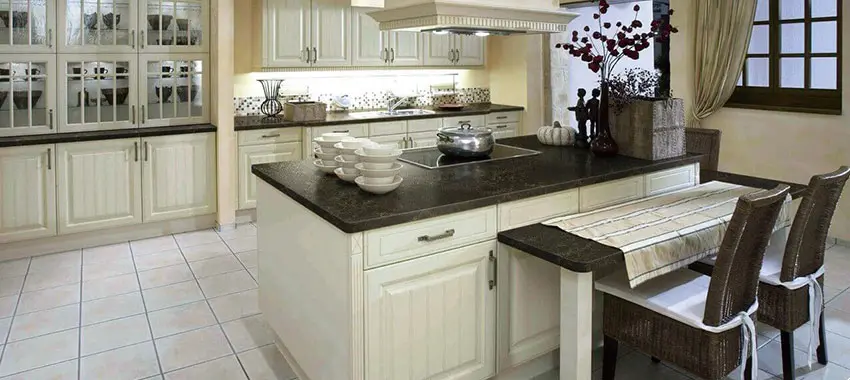
Well, flamed granite countertops are made by torching the surface of granite countertops. This causes a reaction on the top part of the slab and it leads to a dull and rough finish. When you feel the flamed granite countertops, you will feel texture underneath your fingers.

Regular granite is smooth to the touch and it is not gritty at all. Well, flamed granite will have a certain grit to it, which not only aids in gripping things but also helps in ensuring that water doesn’t damage the surface.

A lot of people might think that honed and flamed granite countertops are the same, but they’re not. The process is completely different to achieve said finishes. Flamed countertops are made by the use of heat, whereas honed countertops are made by roughing up the texture of the surface. It is basically buffed to give it that matte and gloss-free finish.

So, flamed granite countertops are definitely in a league of their own, so you will surely take a liking to them if you love countertops that aren’t blinding and overly glossy.

Pros Of Flamed Granite Countertops

So, now that you know what flamed granite finish is, here are all the benefits of this amazing-looking stone and the equally unique finish.

They Have A Rough Finish

One of the major characteristics of flame granite countertops is the finish it has. The finish is very unique. It is matte but not just that. It is also quite gritty in texture and feel, and the topmost surface is rough and very interesting to look at.

If you love the varying textures of countertops and want to install them in your kitchen, then this granite finish will surely impress. It is granite, so what’s not to love? It is a finish that will grow on you and you will come to love it.

Easy To Maintain

Usually, with granite, the maintenance is what makes people not want to get it, because it just requires so much work. There is the cleaning, the polishing, the general care of the material, and it is also not naturally waterproof. This is one of the reasons why people don’t go for granite, even though it has such amazing qualities.

So, you will be happy to know that flamed granite countertops are easier to maintain than regular granite. They are naturally waterproof and they are literally perfect for moist places, which is a shocker, considering that it is the same old granite that is extremely sensitive to water. It is just a simple reaction and a change of texture that makes flamed granite so much better.

Have An Antique Vibe

Flamed granite countertops are great, partly because of the look they have. Flamed granite is a very dull-looking and textured finish that is equal parts matte and gritty. This makes the stone look almost vintage.

If like classic and timeless kitchens, then you will absolutely love flamed granite countertops, because they will transform your kitchen for the better.

A Nice Grip

The texture and feel of flamed granite is very unique. It is very gritty in feel and this is amazing for a number of reasons. First of all, scratches will be a no-show and the countertops won’t look damaged at all. The gritty feel also aids in better grip and that is something that not a lot of countertop materials offer.

They are usually very slippery and you can’t use them to tighten your grip or anything, which can be dangerous, especially if you’re working with sharp things. So, this texture is really fun and you will love the practicality of this granite countertop finish.

Perfect For Outdoors

Flamed granite is perfect for the outdoors. It is very robust, rigid, and it doesn’t mind moisture one bit. Regular granite would not last half as long as flamed granite, especially in the great wide outdoors.

So, if you want to choose a countertop material and finish for your outdoor kitchen, then flamed granite is literally perfect. You will not regret this choice and the flamed finish will live up to its hype and properties. You can even use and install this finish in bathrooms or wherever you work with water.

Cons Of Flamed Granite Countertops

Even though flamed granite is amazing, it is not the best. There will be some things that just don’t vibe well with people. So, here are some of the not-so-good things about flamed granite finish.

Can Be Hard To Find

Flamed granite countertops are not exactly as common as other finishes. Most people love the look of more shiny and glossy countertops, and that is fine, but flamed granite countertops don’t have that sheen or smooth surface that everyone knows and loves about regular granite finishes. This is partly the reason why people have a hard time finding flamed finishes too.

Also, because this technique is very meticulous, you can’t just flame any and every natural stone. It is only applicable for granite and a bunch of other natural stones. So, you might have a hard time finding flamed granite countertops.

Might Look Dull

Flamed granite countertops look really rough and they have an almost dull appearance, not in a bad way, but this is something that not a lot of people get used to. It is just not something that everyone will be drawn to. So, if you think that you won’t like the dull and rough finish of flamed granite, then you might want to go for something else.

Even though the rough texture is really good for the stone quality-wise, a lot of people think that flamed granite doesn’t have the same aesthetics as other granite finishes.

Not Everyone’s Favorite

Tying in with the previous disadvantage, flamed granite has a very peculiar look and it is not everyone’s choice. Usually, people prefer countertops that are shiny, because they tend to look good and they add that very nice bright look to the kitchen.

So, flamed granite is not nearly as popular as glossy and honed granite. People will choose the latter 9 times out of 10. Even though flamed granite is not as popular, it is still loved by a great deal of people who don’t mind the dull and rough texture. So, you take your pick.

Conclusion

Flamed granite finish is unique and beautiful. If you’re tired of the regular glossy and matte finishes, you may like this. Get in touch with a granite installer Rockville to take a look at flamed granite finish and other finishes, like leathered, brushed, sandblasted, bush-hammered, and more.
14

Jan

What Happens In The Countertop Fabrication Process?

So, you’re considering countertop replacement and want to know about the entire countertop fabrication process to know what you’re getting into. Whether you’re choosing quartz, marble, or granite countertops, follow this guide.

What Is Countertop Fabrication?

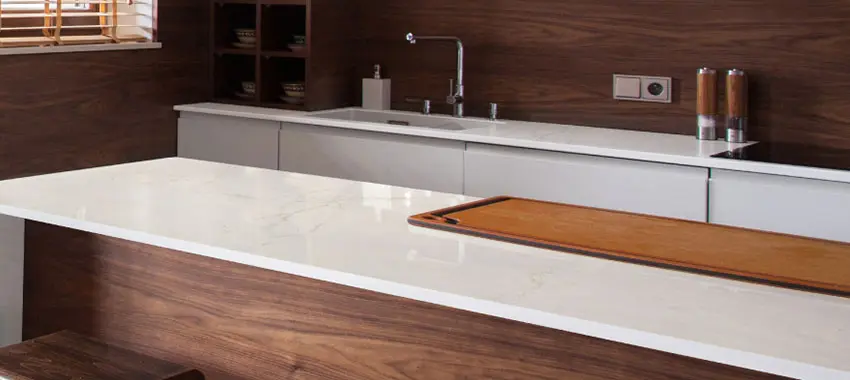
When we say fabrication in the realm of countertops, it means turning raw slabs of any countertop material into custom-made slabs according to the measurements of a specific space and your unique requirements (edging, finishing, etc.).

When you choose a kitchen countertop slab, it can’t be installed directly because it would not fit your kitchen space or it would not have the cutouts as you require, or the edging you want. So, the process through which a raw slab is shaped to your requirements is fabrication.

Keep in mind that there are prefabricated slabs too. They are the ones that are already pre-cut in standard sizes and are pre-polished.

Prefab slabs are cost-effective and faster to install because you only need a day or two for cutouts, trimming the slabs, and changing the surface finish, but there are disadvantages too such as they don’t fit in every kind space as there are width and length restrictions, you can’t choose any type of edging because the choices are limited, there are thickness restrictions, and aligning two prefab slabs with veining may not be perfect.

If you view this as a clothing shopper, prefab slabs are like ready-to-wear clothes, while fabricated slabs are bespoke clothes.

The Countertop Fabrication Process

Choosing The Material

The first step is obvious as it’s about choosing the material. Countertop contractors have a large volume of samples that you can take a look at to choose the material, brand, color, and pattern that speaks to you.

If you like natural stones, popular ones are granite, marble, and quartzite. And then there are also soapstone, limestone, slate, travertine, onyx, sandstone, dolomite, and more.

For those who prefer man-made countertops, quartz is a popular choice. Other engineered stone or man-made materials are solid surface (Corian), porcelain slabs, laminate, sintered stone, cultured marble, cultured granite, and others. You can also choose wood or any other material as well if that is your choice.

Once you choose the material and brand or quality, you pick the right pattern and color. But make sure to avoid outdated kitchen countertop styles. And then we move on to listing down your specifications.

Listing Down Requirements

Requirements are the details of the countertop you want, like the edging profile (eased, beveled, bullnose, ogee, etc.), surface finish (glossy, matte, leathered, etc.), thickness of the slab, cutout details, seams details, backsplash specifications, and others.

The fabricator also lists down what you think of the chosen slab and which part of the slab you want as an island and which parts you want to be hidden or excluded. This is because natural stones usually have unique patterns that are not uniform. So, some parts may appear more beautiful and appealing.

Moreover, there can also be natural characteristics like dry seams, black spots, pits, and other things that you may or may not want in the final product. So, clear communication is important in this step.

Templating

Countertop templating is the process of taking measurements of the space before fabrication. It involves creating a virtual map of the kitchen using a digital templating system, apart from employing the usual tools.

An important part of this step is templating layout. It’s about laying out the captured template onto the slab and finding out which parts of the slab should take the spotlight for best appearance with regard to the kitchen’s lighting and color scheme, and your requirements. This also ensures a smooth flow of the veining. Plus, this step marks the cutouts, seams, edges, and other details.

More simply, it’s an advanced way of marking the slab before cutting for the best appearance and to prevent errors.

Cutting The Stone

This is the crucial step of cutting the stone into pieces that would fit together in the later step. If the templating is done correctly, this step is quite straightforward because the stone is cut down as required. Fabricators use tools like saw bridges, water jets, and grinders to accomplish the job.

Fabricating The Stone

In the cutting step, the stone is cut precisely, but there are no refinements or finishing done. It’s because this step, fabrication, is all about that. Now, this can be a bit confusing because the entire process from choosing the material to installing the slab is called fabrication and this step within it is also known as fabrication. So, to make things easier, we will call this step refining the cut stone.

This part requires a CNC machine and a skilled operator for creating sink and cooktop cutouts, producing the specified edge profile, and polishing the slab around the edges mainly.

Polishing The Slab

As stated above, the CNC machine polishes slabs around the edges. That is due to the fact that the CNC machine polishing larger surfaces is not efficient. So, full-surface polishing is performed in this step. The fabrication team will use tools like slab polishers and also perform hand polishing for a beautiful and appealing finish.

After this step, a sealer is also applied if you have a natural stone slab. This is because natural stones are porous and allow moisture to seep in, which can result in staining, fading, and damage. So, a sealer is applied. And the fabricator will also suggest that you seal your natural stone countertop once every few years to retain its appeal.

Final Inspection

The slab has been cut, refined, polished, and sealed. It’s ready to be delivered, but the fabricator’s job is not finished yet. A final inspection is required to make sure that the slab doesn’t have any imperfections or flaws. Once reviewed and approved, we move on to the installation step.

Installation

The final step is installation, where the slabs are properly laid and secured. Any larger parts are cut which were left intentionally to prevent damage to the actual slab. The installer will align seams meticulously to make them unnoticeable or invisible. After this, the sink and appliances are installed and sealed with silicone sealing to avoid water leakages. Then, the backsplash is installed if included in the instructions.

Lastly, a final polish is done to remove installation marks, dust, and everything else, and make the surface look fresh.

How Long Does Countertop Fabrication Take?

The exact timeline varies based on the countertop size and the material. However, in most cases, the countertop fabrication process takes from 1 to 2 weeks. Usually, natural stones take longer than engineered stone because there are added steps like polishing and sealing.

Plus, if there are complex designs and multiple sinks and other cutouts involved, it would take one or two more days.

Conclusion

Countertop fabrication begins with you choosing the material and ends with a stunning countertop surface in your kitchen. But it takes time and a lot of work, and now you know how it all happens. So, apart from picking the right material and quality, choosing the right countertop replacement services Potomac is also critical because they will use specialized tools and techniques for fabricating slabs to look exactly as you envision.